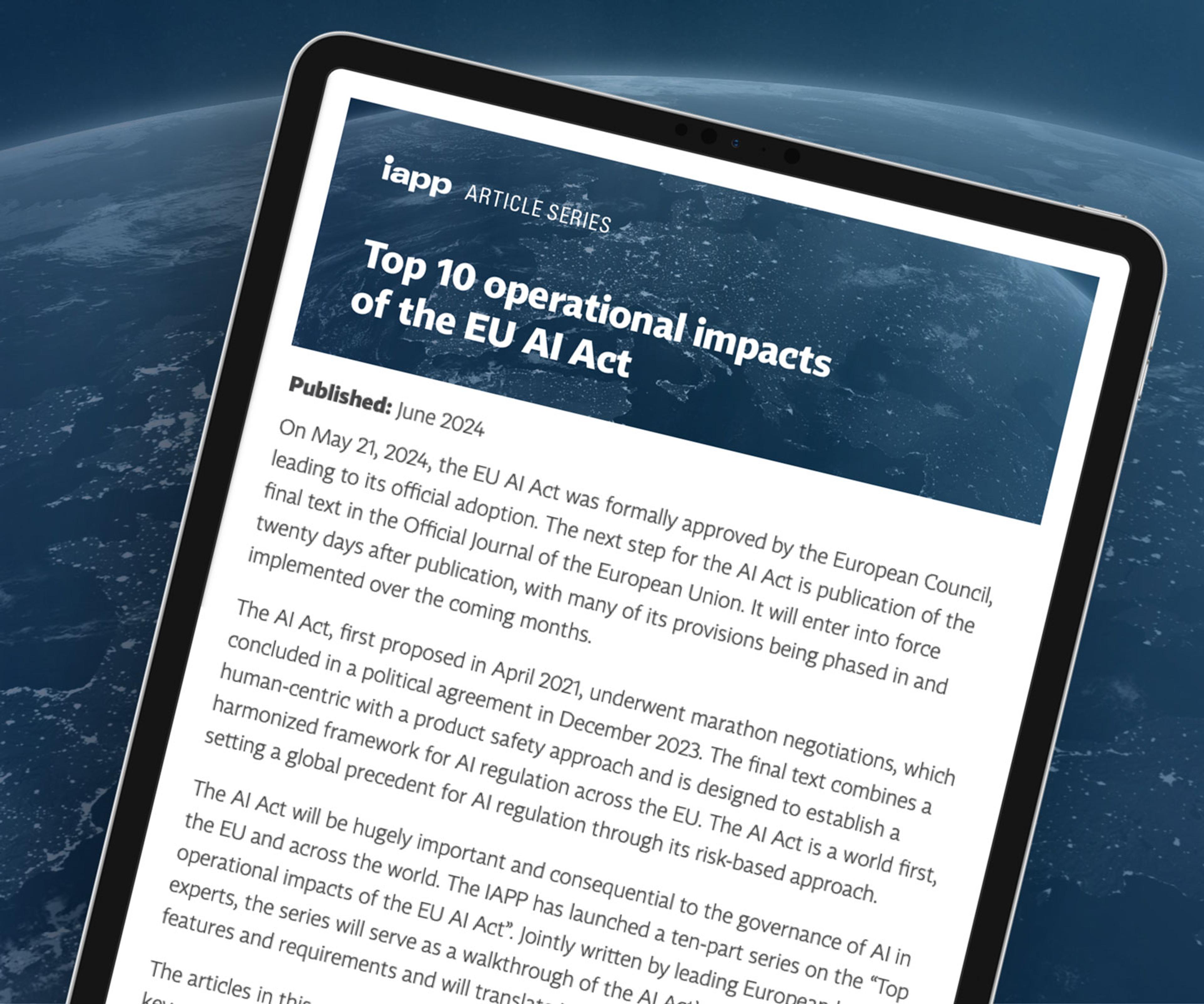
Top 10 operational impacts of the EU AI Act – Obligations on providers of high-risk AI systems
This article provides insight into obligations on providers of high-risk AI systems in relation to the EU AI Act.
Published: 14 Aug. 2024
This article is part of a series on the operational impacts of the EU AI Act. The full series can be accessed here, with the other articles in the series listed below.
Providers of high-risk AI systems will need to know Chapter III of the EU AI Act very well. Sections 2 and 3 of Chapter III set out the requirements a provider must meet when making a high-risk AI system available on the EU market.
One way to categorize these different requirements is dividing them broadly into organizational, documentation, system design and regulatory requirements, while recognizing that certain articles perform dual roles.
This article provides insight into obligations on providers of high-risk AI systems in relation to the EU AI Act.
Top 10 operational impacts of the EU AI Act
The overview page for the series can be accessed here.
- Subject matter, definitions, key actors and scope
- Understanding and assessing risk
- Obligations on providers of high-risk AI systems
- Obligations on nonproviders of high-risk AI systems
- Obligations for general-purpose AI models
- Governance: EU and national stakeholders
- AI Assurance across the risk categories
- Post-market monitoring, information sharing and enforcement
- Regulatory implementation and application alongside EU digital strategy
- Leveraging GDPR compliance

This content is eligible for Continuing Professional Education credits. Please self-submit according to CPE policy guidelines.
Contributors:
Olivier Proust
Partner, Technology and Data, Fieldfisher
CIPP/E
Victoria Hordern
Partner, Data Protection and Privacy, Taylor Wessing
AIGP, CIPP/E, CIPT
Tags:
Top 10 operational impacts of the EU AI Act – Obligations on providers of high-risk AI systems
This article provides insight into obligations on providers of high-risk AI systems in relation to the EU AI Act.
Published: 14 Aug. 2024
Contributors:
Olivier Proust
Partner, Technology and Data, Fieldfisher
CIPP/E
Victoria Hordern
Partner, Data Protection and Privacy, Taylor Wessing
AIGP, CIPP/E, CIPT
This article is part of a series on the operational impacts of the EU AI Act. The full series can be accessed here, with the other articles in the series listed below.
Providers of high-risk AI systems will need to know Chapter III of the EU AI Act very well. Sections 2 and 3 of Chapter III set out the requirements a provider must meet when making a high-risk AI system available on the EU market.
One way to categorize these different requirements is dividing them broadly into organizational, documentation, system design and regulatory requirements, while recognizing that certain articles perform dual roles.
This article provides insight into obligations on providers of high-risk AI systems in relation to the EU AI Act.
Top 10 operational impacts of the EU AI Act
The overview page for the series can be accessed here.
- Subject matter, definitions, key actors and scope
- Understanding and assessing risk
- Obligations on providers of high-risk AI systems
- Obligations on nonproviders of high-risk AI systems
- Obligations for general-purpose AI models
- Governance: EU and national stakeholders
- AI Assurance across the risk categories
- Post-market monitoring, information sharing and enforcement
- Regulatory implementation and application alongside EU digital strategy
- Leveraging GDPR compliance
This content is eligible for Continuing Professional Education credits. Please self-submit according to CPE policy guidelines.
Tags:
Related resources
Global AI Governance Law and Policy: Jurisdiction Overviews

EU Digital Laws Report 2025
Global AI Law and Policy Tracker